

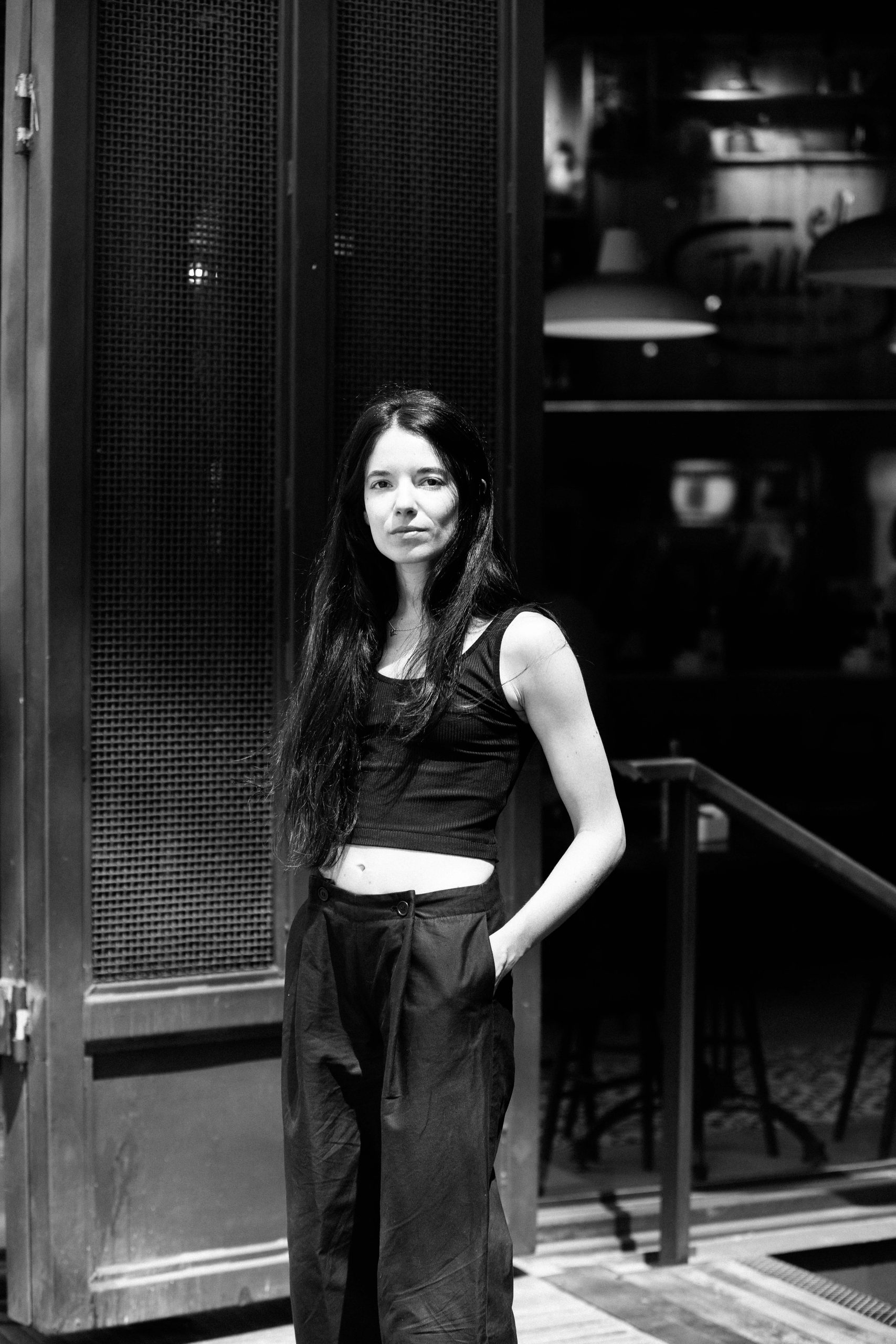
Chiara Arrigoni is a playwright, actress, screenwriter, and story editor. She graduated with honors in Classics and earned a degree in Playwriting and Screenwriting from the Silvio d’Amico National Academy of Dramatic Art in Rome, where she co-founded the theatre company Le ore piccole with fellow alumni. In 2025, she won the ‘Franco Quadri’ Special Mention at the Premio Riccione for her play SEG MEN TAR SI – Dis-integrazione dell’umano, which also won the 2025 Premio Omissis. With her plays Le nuove madri and Pelle, she received two commendations at the Premio Hystrio Scritture di Scena and a Jury Mention; Pelle was also awarded an English translation mentorship as part of the New York Italian Theatre Festival In Scena!, in collaboration with NYU, where it was presented as a staged reading. Her plays have been selected for festivals and showcases in Italy, France, Switzerland, and the United Kingdom, earning both national and international recognition.
In 2019, she was selected for the NEON_10 project by Fabulamundi Playwriting Europe, spanning Italy, Poland, and Romania. In 2022, she founded the cultural association Quarto Bivio Lab, through which she develops live performance, training, and urban regeneration projects through culture. In 2025, she took part in a residency in Santiago, Chile, as part of a program promoting Italian theatre worldwide, organized in collaboration between the Associazione Riccione and the Italian Cultural Institute in Santiago.
Selected play: Le nuove madri[The New Mothers]
Synopsis: “The mothers of the future, the mothers who will in turn become mothers in the coming centuries and millennia, or tens of millions of years—what will happen when they have completely forgotten?”
In “a world almost like ours, but not quite like ours,” live a young couple, Ani and Abel, who have just had a baby girl; a Mother who refuses to resign herself to the passage of time and still wants to derive the greatest possible pleasure from sex; a young Nanny who looks after the baby; and various other characters, such as A Random Woman, an activist protesting for different causes. In the time and space of the story, women no longer need to bear the burden of pregnancy and childbirth; fertilization and gestation take place in clinics through machines, and parents can simply go pick up their baby when it is “ready.” Everyone agrees that a world where women are finally freed from the pain of childbirth is a better world, and there are even amusement parks where anyone—women and men alike—can experience natural childbirth, if they wish. Yet, a question creeps into the protagonists’ happiness: once even the biological memory of childbirth has been erased, who will the new mothers be? Could a new era dawn in which men take on the role of mother?