
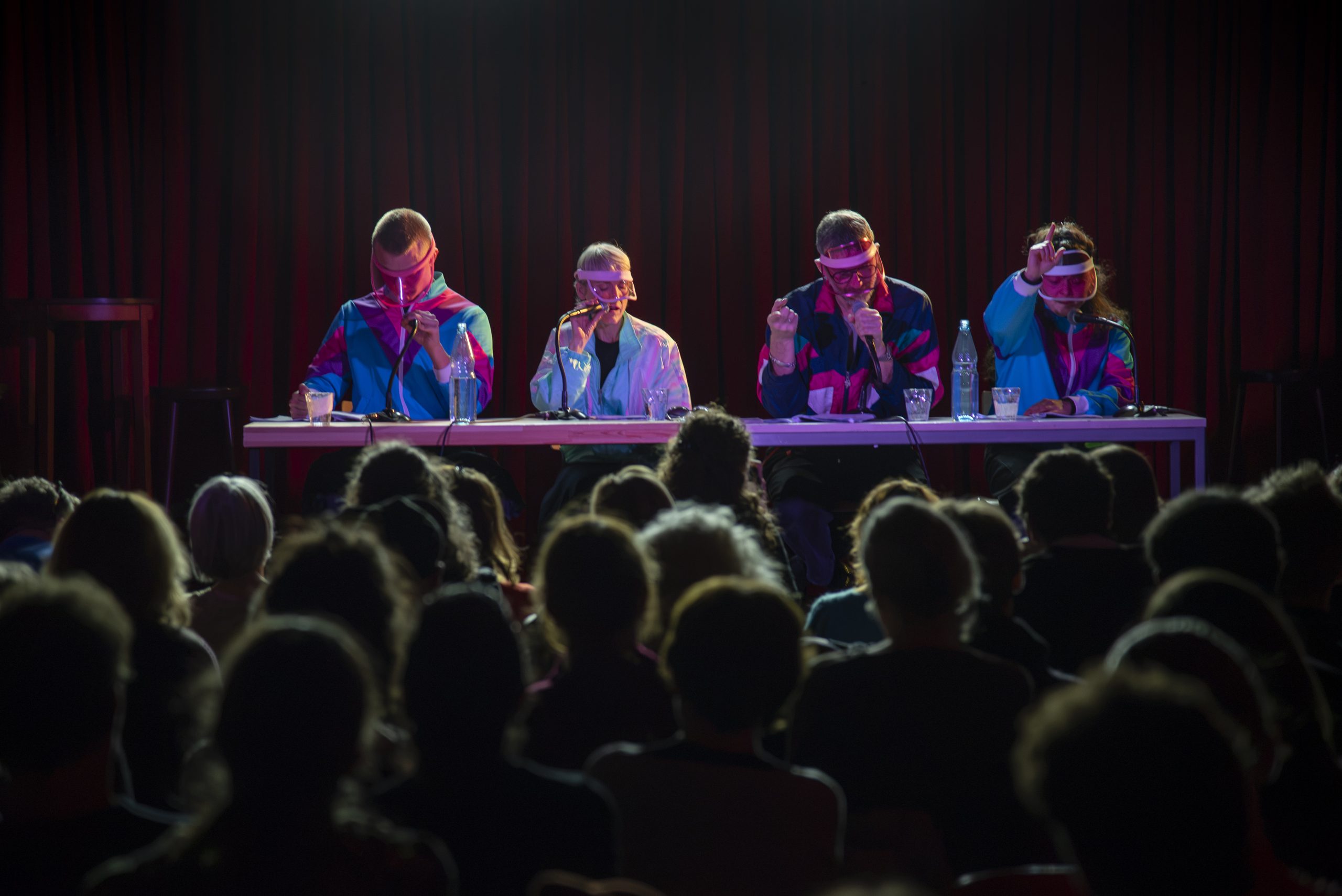
Four intense days, six plays, twelve actors, three directors: from 4th to 7th November, the first public highlight of the European project MEDUSA: Contemporary Playwriting and Inclusive Identities in Europe took place in Berlin.
An opening public talk at the German Centre of the ITI was followed by three festival evenings at the Roter Salon in the Volksbühne am Rosa Luxemburg Platz with around 350 audience and team members. The enthusiastic feedback showed just how much buzz contemporary drama can generate – particularly when previously unknown texts are presented to an audience for the first time in a new language.
Opening Event at the ITI: Translation Alone is Not Enough
The festival opened on the 4th of November with the event From Translation to Circulation: Three European Perspectives at the German Centre of the International Theatre Institute in Bethanien Art Centre.
Project partners from Germany, Bulgaria and Italy had a discussion with the audience for an hour and a half – because there was plenty to discuss: why is it that even plays that have already been translated get barely any attention or get performed? It became clear that structural obstacles such as a lack of funding, different theatre and publishing systems, and a lack of networks are by no means new problems, but have always been a feature of the international dissemination of drama. A translation alone is not enough: it needs people and institutions to read it, spread it to others and get it on stage.


Photo: Anna Galt.
Day 1: Foreignness and Belonging
The first night of the festival focussed on foreignness and belonging. Marie Bues created two extremely visual staged readings. In Silva Marinova’s FETTSACK (FATASS), translated from the Bulgarian by Alexander Sitzmann, a video projection accentuated the play’s bizarre and delirious science-fiction world. Existential questions about body image, loss and the social pressure to constantly improve oneself behind the grotesque humour were also brought to the fore.
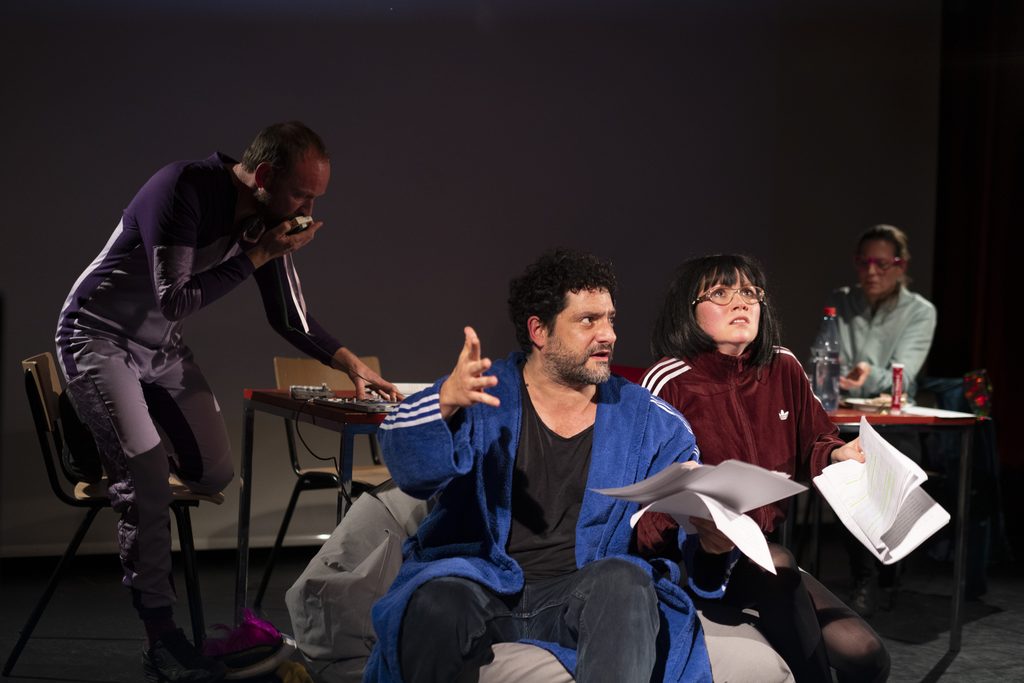
[FETTSACK (FATASS) by Silva Marinova. From left: Anton Berman, Edgar Barroso, Barbara Behrendt, Aylin Esener. Credits: Manaf Azzam]
One the other hand, Tatjana Motta’s mysterious and unsettling Lange Nacht (Long Night), translated from the Italian by Henrieke Markert, brilliantly captured the feeling of being a stranger in a city at night and the gradual loss of familiar points of orientation. In the deep red light of the Roter Salon, the reading created an atmosphere that was almost reminiscent Twin Peaks.
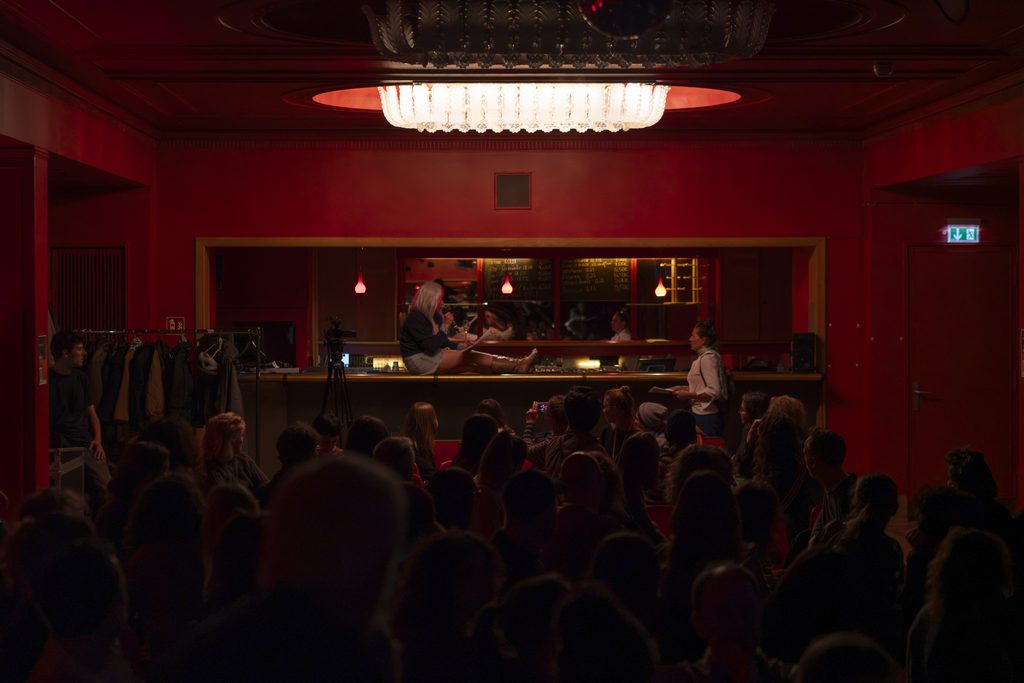
[Photo: Lange Nacht (Long Night) by Tatjana Motta. From left Barbara Behrendt, Aylin Esener. Credits: Manaf Azzam.]
The discussion afterwards focused primarily on what a text like this does to its translation: how can the translation convey a language that is strongly characterised by orality, while remaining abstract and detached? Henrieke Markert described this tension as a key challenge in the translation of Lange Nacht.
Day 2: Body, Class and Gender
On the second night of the festival, Tobias Herzberg brought two texts about social stereotypes and their effects on the body to the stage. In Lena Riemer’s aufstiegskörper. ein fühlversuch (ascending bodies. a felt experiment), the strong physical presence of the actors made tangible how classism, the pressure to fit in and the codes of the German education system are inscribed into language and the body.
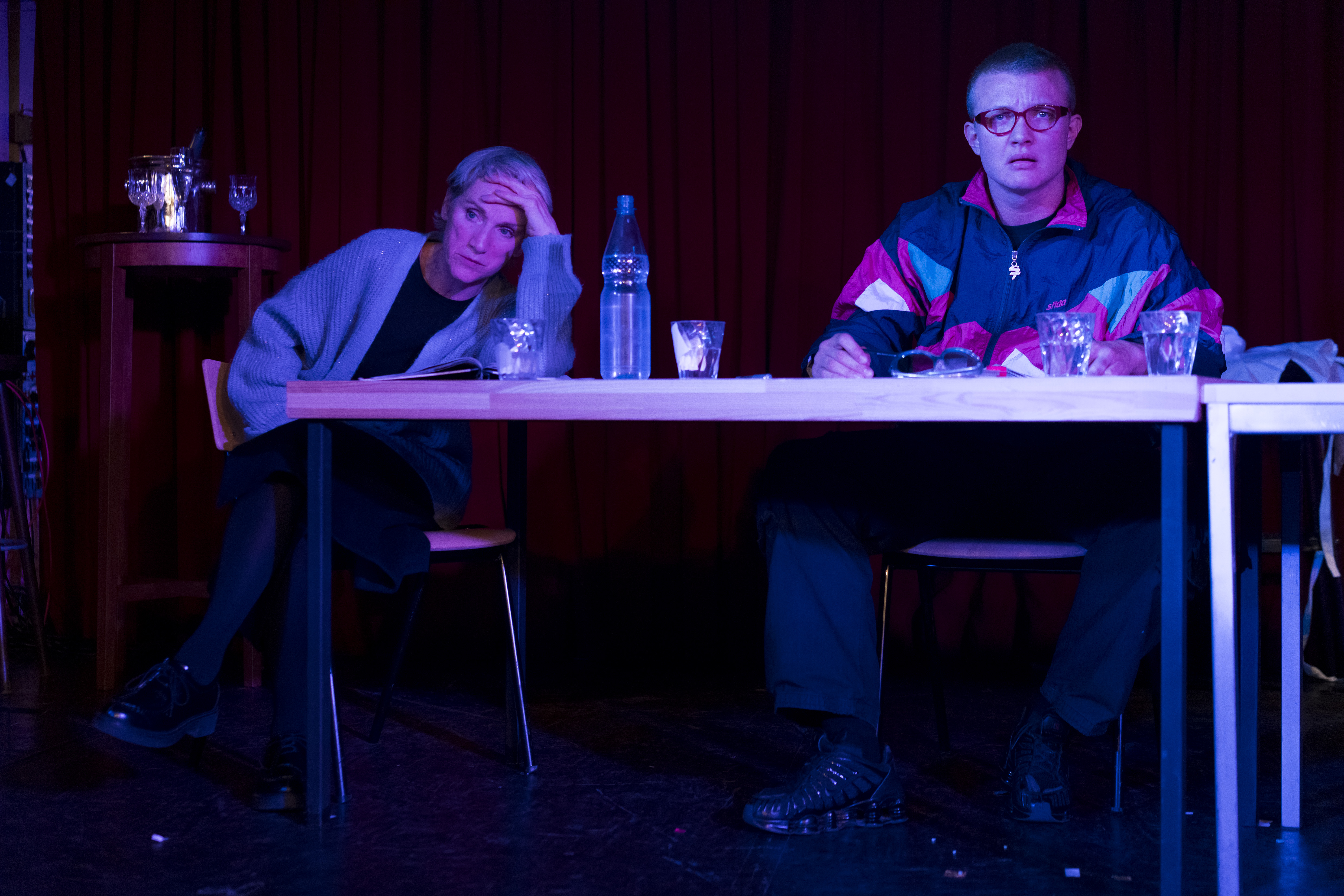
[Photo: aufstiegskörper. ein fühlversuch by Lena Riemer. From left: Theresa Berlage, João d’Orey. Credits: Jana Kießer]
Alessandro Paschitto’s SEXUS, in contrast, revealed a multifaceted panorama of gender, desire and male dominance through realistic, absurd and allegorical scenes.
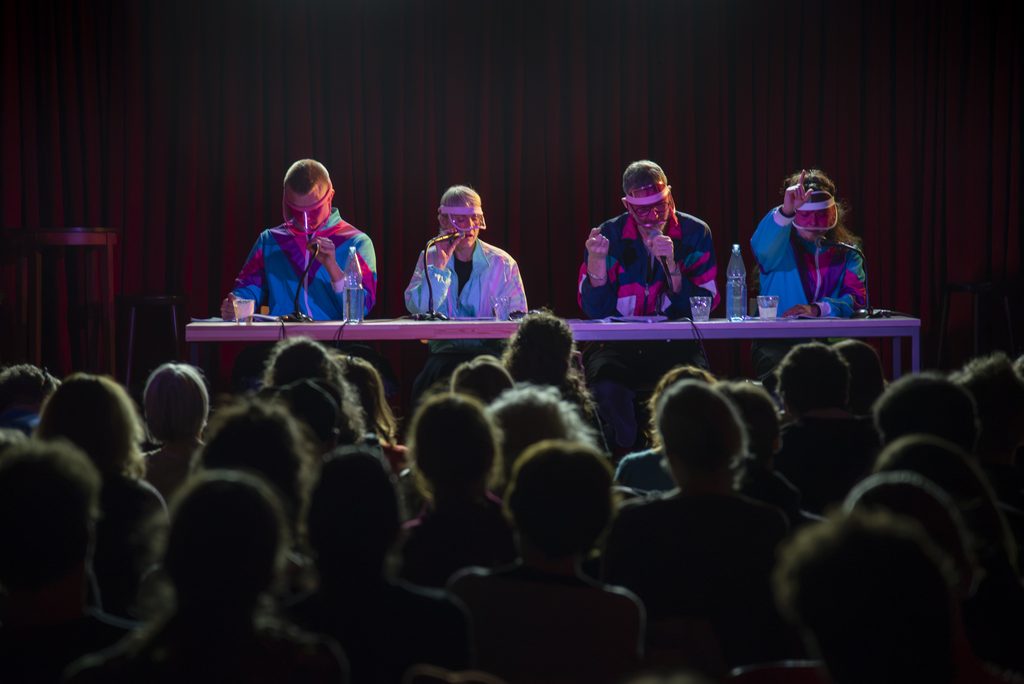
[Photo: SEXUS (SESSO) by Alessandro Paschitto. From lefts: João d’Orey, Theresa Berlage, Knut Berger, Via Jikeli. Credits: Manaf Azzam]
The discussion with Lena Riemer, Alessandro Paschitto, translator Carola Köhler and Tobias Herzberg centred on the productive friction that arises when a play translated from Italian is performed by a German-speaking ensemble for a Berlin audience. In a different language, the sphere of discourse also shifts: questions about gender, sexuality and power are linked to different ideas, experiences and debates.
Day 3: Community, Violence and Addiction
On the third night of the festival, Salome Dastmalchi directed two powerful and physically intense readings. Teodora Georgieva’s rhythmically poetic Stark. Mutig. Gefährlich (Strong. Brave. Dangerous) showed how violence and aggression arise, are learned and passed on in a group of boys.
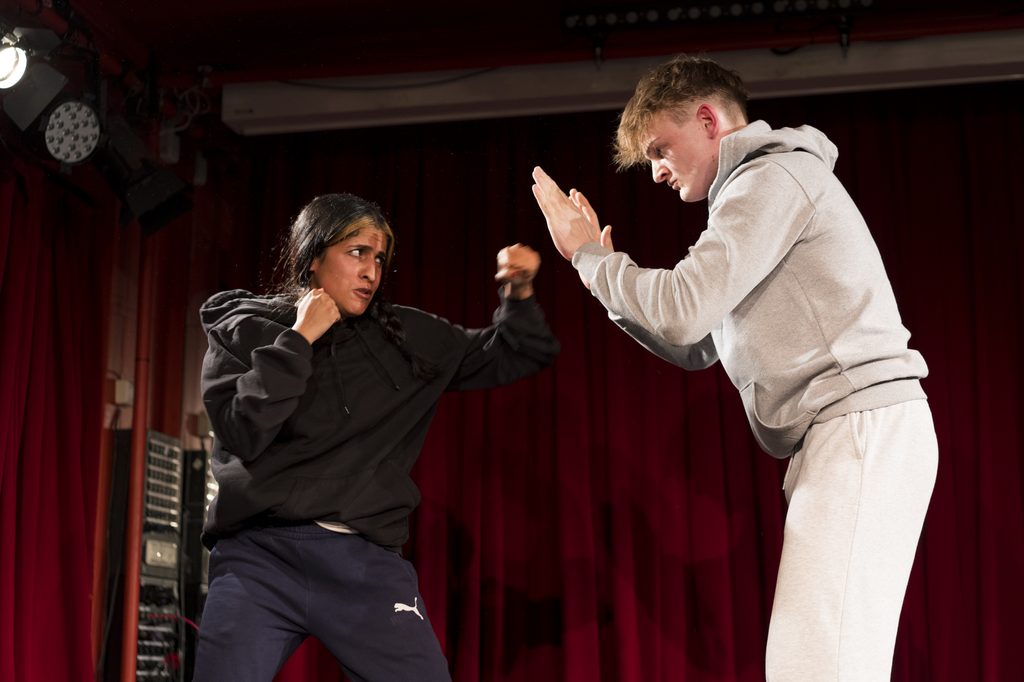
[Photo: Stark. Mutig. Gefährlich. by Teodora Georgieva. From left: Banafshe Hourmazdi, Niklas Wetzel. Credits: Jana Kießer]
In Natalie Baudy’s under the influence oder: die rückkehr der bakchen (under the influence or: the return of the bacchae), three women from different generations (played by men in the reading) come up against Banafshe Hourmazdi as the exhausted goddess Dionysa. Combining black humour, intoxication, ecstasy and apocalyptic menace, the play explored themes of addiction, patriarchal structures and female solidarity.
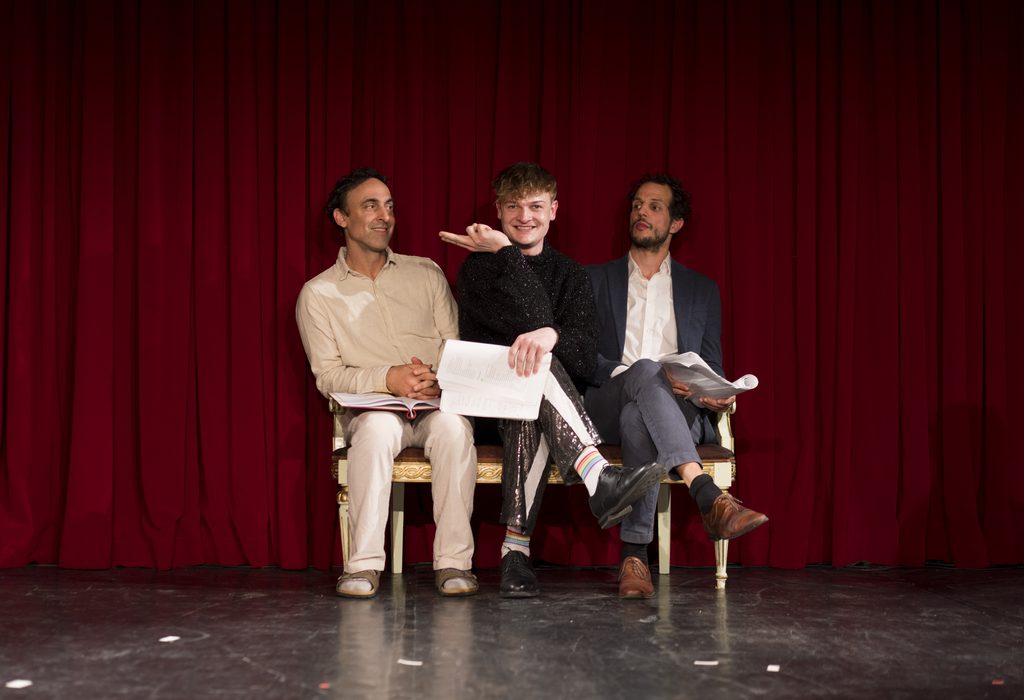
[Photo: under the influence oder: die rückkehr der bakchen von Natalie Baudy. From left: Patrick Khatami, Niklas Wetzel, Nadim Jarrar. Credits: Jana Kießer]
Alexander Sitzmann’s powerful translation was praised in the discussion. The relevance of violence in Bulgaria today, as described by Teodora Georgieva, and the state of contemporary Bulgarian drama was also discussed, as was how Natalie Baudy’s play explores how we can live and survive together in these uncertain, post- pandemic times. While women’s alcohol consumption is often subject to greater social moralising and stigmatisation than that of men, the play examines the liberating potential of intoxication and ecstatic states without glossing over its ambivalence.
The festival closed with music and dancing to DJ sets by DJAZ and DJ SAESH.
The Journey Continues
Berlin was only the first stop of the MEDUSA project. All the plays will be translated into German, Italian, Bulgarian and English, and presented in staged readings at the end of February in Sofia and at the start of June in Naples. And so the texts will continue their journey, encountering new voices, bodies and perspectives.
The German national cultural radio station Deutschlandfunk Kultur also reported on MEDUSA and the international circulation of contemporary theatre texts. You can
listen to it here: https://www.deutschlandfunkkultur.de/zeitgenoessische-theatertexte-im-europaeischen-kontext-das-medusa-festival-100.html
We would like to thank both everyone involved and the audience, who received the new texts with great openness and curiosity and helped to make the discussions so lively.
—
MEDUSA is funded by the European Union’s Creative Europe programme. The Berlin festival was also supported by the Berlin Senate Department for Culture and Social Cohesion and produced in cooperation with the Volksbühne am Rosa-Luxemburg-Platz.